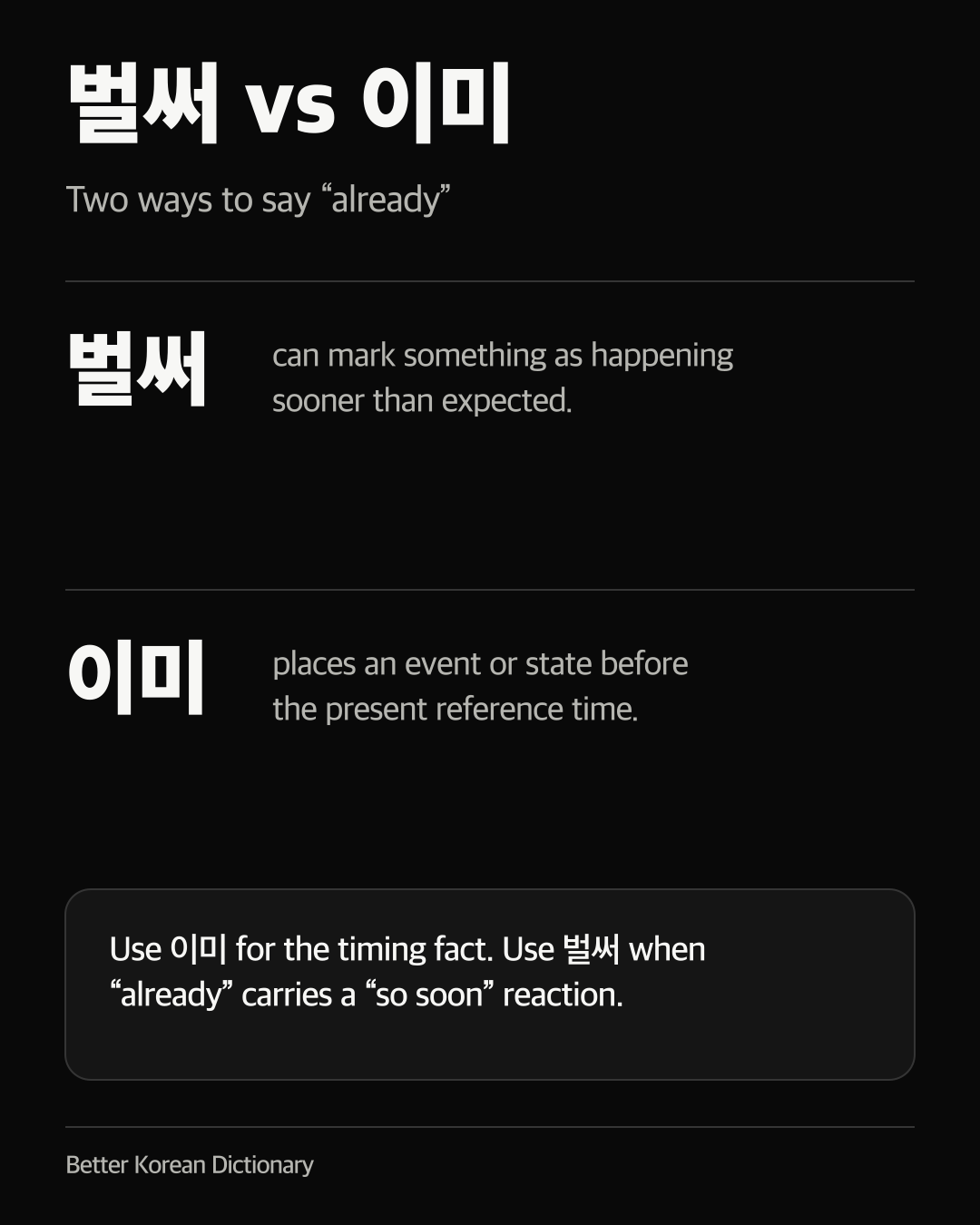
벌써 vs 이미
Both can mean “already.”
이미 says that something happened before the reference time. 벌써 can instead highlight that it happened sooner than expected, and it also has a separate “long ago” sense.
Source-verified August 19, 2026. AI-assisted and checked against the released dictionary and NIKL sources.
The quick answer
Use 이미 for the timing fact. Use 벌써 when “already” carries a “so soon” reaction.
벌써
벌써 can mark something as happening sooner than expected.
아직 겨울이 다 지나가지도 않았는데 옷 가게에는 벌써 봄옷들이 걸려 있다.이미
이미 places an event or state before the present reference time.
친구는 정신없이 달려왔지만 이미 버스는 떠난 뒤였다.One useful caveat
벌써 does not always express surprise because its second dictionary sense means “long ago.”
Look up the next confusing pair
Find more Korean word distinctions in Better Korean Dictionary.
Sources and method
This guide was generated from a versioned lesson record, checked by separate grounding and adversarial passes, and blocked from publication until both passed. It is not described as human-reviewed.
- National Institute of Korean Language entry for 벌써
- National Institute of Korean Language entry for 이미
- NIKL copyright and reuse policy
Source examples are adapted from the National Institute of Korean Language's Korean-English Learners' Dictionary under its Attribution-ShareAlike terms.
Report a correction